
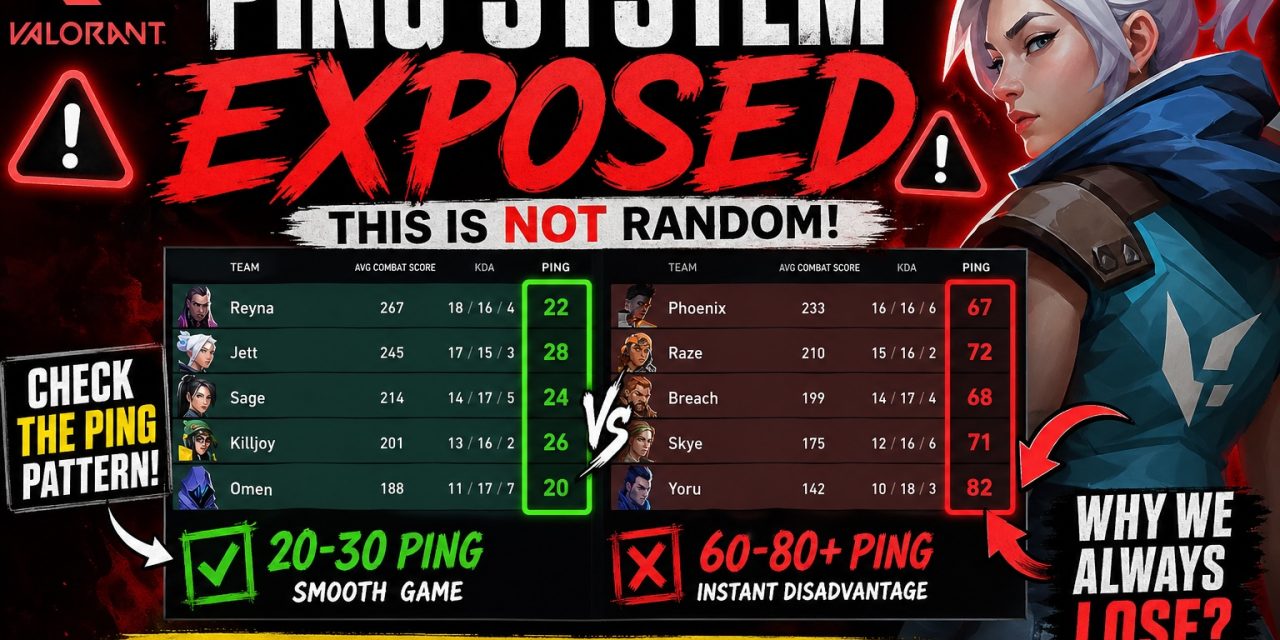
If you’ve played Valorant long enough—especially in low elo—you’ve probably had this thought:
“Why is my team suddenly on 70–90 ping while the enemy is chilling at 20–30? Is the game deciding who wins?”
It’s a powerful feeling. And for many players, it doesn’t feel random.
Some even claim they can predict the outcome of a match just by looking at the scoreboard ping at the start.
So the big question is:
Is Valorant secretly controlling ping to influence matches?
Let’s break this down—because the truth is more interesting than the conspiracy.
Where This Theory Comes From
Players in low ranks (Iron to Gold especially) often notice:
- One team consistently has lower ping
- The other team struggles with 60+ ms or unstable latency
- The “high ping team” tends to lose more often
- This pattern repeats across multiple matches
After seeing this a few times, it starts to feel intentional.
And that’s where the idea of “Valorant controls matches through ping” starts gaining traction.
What Ping Actually Is (And Why It Fluctuates)
Ping is simply the time it takes for your input to reach the game server and come back.
It depends on:
- Your distance to the server
- Your ISP routing
- Network congestion
- Server load balancing
- Background apps using bandwidth
Here’s the key point:
Riot does not directly control your ISP routing or your physical network conditions.
So while Riot controls matchmaking and server allocation, they don’t have fine-grained control to selectively “boost” or “nerf” ping for specific teams mid-match.
So Why Does It Feel Like One Team Has Worse Ping?
This is where things get interesting—and where your observations actually have some truth.
1. Server Selection Isn’t Always Equal
Valorant chooses a server that works best overall for all 10 players.
That doesn’t mean it’s equally good for everyone.
Example:
- 5 players from Lahore
- 3 from Karachi
- 2 from Dubai
The chosen server might give:
- 20 ms to one group
- 60 ms to another
This creates the illusion of imbalance—even though it’s just geography and routing.
2. Low Elo Has More Network Variability
In lower ranks:
- More players use WiFi instead of Ethernet
- More shared internet connections (homes, hostels, cafes)
- More unstable ISPs
So naturally:
- Ping spikes are more common
- Packet loss happens more frequently
This makes matches feel inconsistent—and sometimes unfair.
3. Confirmation Bias Is Strong
Once you notice a pattern, your brain starts locking onto it.
You remember:
- Games where high ping = loss
You forget:
- Games where high ping team still won
- Games where both teams had similar ping
This is called confirmation bias, and it’s extremely powerful in competitive games.
Does Higher Ping Actually Affect Winning?
Yes—but not always in the way you think.
Higher ping can cause:
- Delayed hit registration
- Peeker’s advantage issues
- Slower reaction feel
But:
60–70 ms ping is still very playable in Valorant.
Many players perform well even at 80–100 ms if their connection is stable.
The real issue isn’t just ping—it’s inconsistency.
The Real Problem: Ping Stability, Not Ping Value
Here’s what matters more than “high ping”:
- Jitter (ping fluctuation)
- Packet loss
- Spikes during fights
A player at:
- Stable 70 ms → playable
- Jumping 20 → 120 ms → unplayable
This is what actually ruins matches.
Could Riot Be Manipulating Matches? Let’s Be Real
For this theory to be true, Riot would need to:
- Detect which team should win
- Dynamically alter network routing
- Artificially increase/decrease latency per player
- Do this in real-time without detection
That’s not just unlikely—it’s operationally impractical and risky.
Why?
- It would destroy competitive integrity
- Pro players would detect it instantly
- Network engineers and data miners would expose it
Riot’s entire business depends on trust in ranked fairness.
So Why Do Some Matches Feel “Rigged”?
Because multiple systems collide:
Matchmaking
- Skill gaps still exist in low elo
- Smurfs can dominate games
Network Conditions
- Uneven routing across regions
- ISP differences
Player Behavior
- Tilt, communication issues, inconsistency
When all of these align, it feels like the game is controlling outcomes.
But it’s actually chaos—not conspiracy.
Low Elo Trap: The Real Reason Players Get Stuck
This part is important.
Many players blame:
- Ping
- Teammates
- “System control”
But in reality, players stay in low elo because of:
- Inconsistent aim
- Poor positioning
- Lack of communication
- Tilt after losing rounds
Blaming ping becomes an easy explanation—but it stops improvement.
How to Actually Test Your Theory (Smart Way)
Since you have screenshots, here’s how to make your article stronger:
Instead of claiming manipulation, analyze:
- Average team ping across 20–30 matches
- Win/loss correlation
- Ping stability vs performance
If you present data, your content becomes far more credible—and still viral.
Viral Angle That Actually Works
Instead of saying:
“Valorant is controlling ping to decide winners”
Say:
“I Thought Valorant Was Rigging My Matches… Until I Analyzed 30 Games”
or
“High Ping = Instant Loss? I Tested This in Valorant Low Elo”
This hooks readers while keeping your argument strong.
Final Verdict
- Ping differences between teams are real
- They can affect gameplay
- But they are not intentionally manipulated to decide winners
What you’re experiencing is:
A mix of network conditions, matchmaking variance, and human perception.






wow , this is really strange to know