
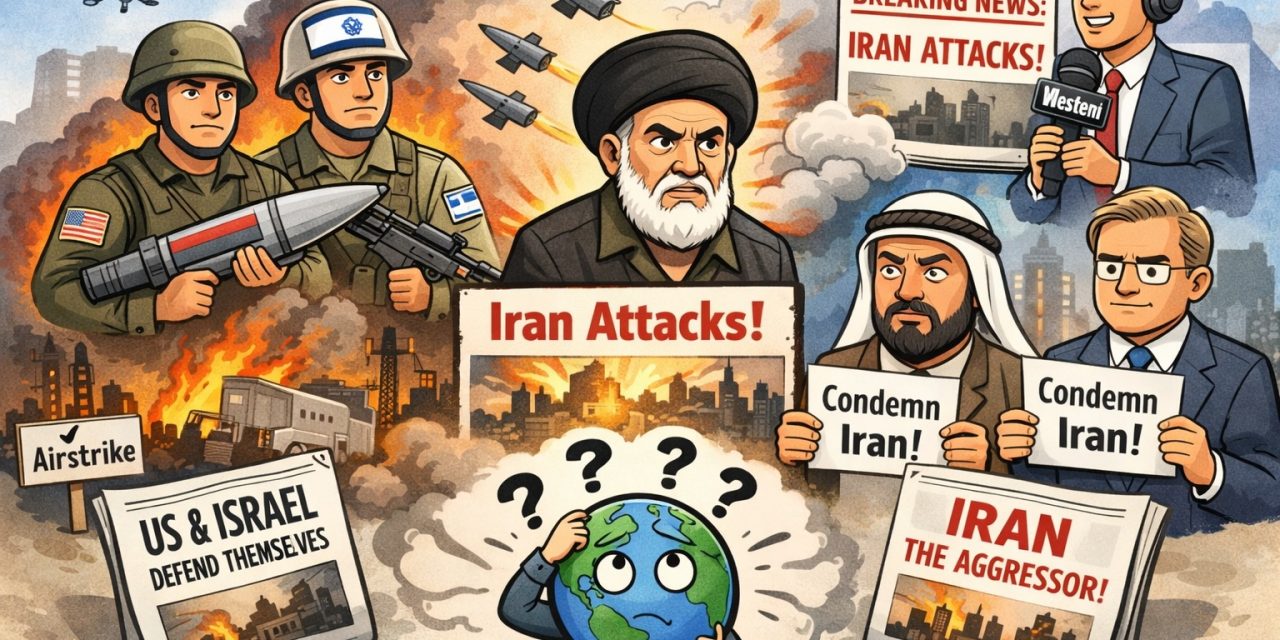
War, Narratives, and Neutrality: Why Global Reactions to the US–Israel–Iran Conflict Are Being Questioned
The current war involving the United States, Israel, and Iran has once again exposed how modern conflicts are fought not only on battlefields, but also in the media, diplomacy, and public opinion. In every major war of recent decades, the first casualty has often been truth. Competing narratives, selective reporting, and political alliances shape how the world understands who started the conflict, who is defending, and who is being blamed.
In this conflict, many observers argue that the situation is being presented in a way that does not fully reflect the sequence of events. According to these views, the escalation did not begin with Iran, but rather with actions taken by the United States and Israel, including strikes on strategic locations, energy infrastructure, and military targets. However, international coverage has frequently focused on Iranian retaliation while giving less attention to what triggered it.
This has led to growing debate about whether global reactions are based on facts, alliances, or political interests.
The Question of Who Started the War
One of the most disputed issues in this war is the question of who initiated the escalation.
Supporters of the Western position argue that Iran’s regional activities, missile programs, and support for armed groups created the conditions that made confrontation unavoidable.
On the other hand, critics say that direct military actions by the United States and Israel — including targeted strikes and operations inside or against Iranian interests — played a decisive role in turning tension into open conflict.
In many conflicts, retaliation is reported more widely than the initial strike.
This creates a perception that the side responding is the aggressor, even if the situation is more complex.
This raises an important question:
When a war begins with a strike, why is the response sometimes reported more strongly than the strike itself?
Media Coverage and Allegations of Bias
International media plays a powerful role in shaping public opinion during war.
Large global news networks are often based in countries that are politically aligned with one side of the conflict, which can influence tone, terminology, and emphasis.
Critics of current coverage say that reports often highlight claims that Iran attacked civilian areas, energy facilities, or infrastructure, while giving less coverage to earlier attacks carried out by the United States or Israel.
Supporters of the media reject the idea of bias and argue that reporting depends on available information, verification, and access to sources, which can be limited during war.
Still, the perception of unequal coverage remains strong in many parts of the world, especially in regions that already distrust Western foreign policy.
When audiences repeatedly see one side condemned and the other side justified, even in complex situations, the credibility of international reporting is questioned.
Silence and Diplomacy Among Muslim Countries
Another issue being widely discussed is the reaction of Muslim-majority countries.
Many people expected strong and unified statements from Muslim governments when the conflict escalated. Instead, most official responses have been cautious, diplomatic, or neutral in tone. Some governments have called for restraint from all sides, while others have avoided directly criticizing the United States or Israel.
This has led to frustration among many citizens who feel that Muslim countries speak strongly on some issues but remain quiet on others.
Several reasons are often suggested for this diplomatic approach:
- Economic dependence on Western countries
- Security agreements with the United States
- Regional rivalries between Muslim nations
- Fear of wider war affecting oil markets and trade
- Internal political considerations
Because of these factors, governments may choose careful language instead of strong condemnation, even when public opinion is more emotional.
This creates another question being asked across the world:
Are governments acting according to principles, or according to interests?
Why Energy Facilities and Civilian Targets Become Central in War Narratives
In modern warfare, attacks on energy infrastructure, power plants, and strategic facilities often become major headlines.
These targets are important because they affect the economy, public life, and global markets.
When such attacks are reported, they can quickly shape international opinion.
However, critics say that similar actions by different sides are not always described in the same way.
One attack may be called “defensive,” while another is called “aggressive,” even if both target similar facilities.
This difference in language can influence how the world decides who is right and who is wrong.
War reporting often depends on political context, not only on the event itself.
The Role of Global Alliances
The reaction of Europe, the United States, and many allied countries has largely followed established political alliances.
Countries that are part of the same security partnerships often support each other diplomatically, even when calling for peace.
This does not necessarily mean they approve every action, but it does mean their statements are rarely fully neutral.
At the same time, countries outside these alliances may see the situation differently, leading to completely opposite interpretations of the same events.
Because of this, global conflicts are no longer judged only by facts on the ground, but also by geopolitical alignment.
Questions Being Asked Around the World
As the war continues, many people — not only in the Middle East, but globally — are asking difficult questions:
- Why are some attacks condemned immediately while others receive limited attention?
- Why do powerful countries often define what is called aggression and what is called defense?
- Why do many governments speak about peace but avoid criticizing their allies?
- Why do Muslim countries call for unity but rarely act together during major conflicts?
- Why does international media sometimes appear divided along political lines?
These questions do not have simple answers, but they show how trust in global institutions is being tested.
The Need for Real Neutrality
In any war, neutrality is difficult.
Countries have alliances, media has perspectives, and governments have interests.
However, when neutrality disappears completely, public confidence also disappears.
People begin to believe that justice depends on power, not on facts.
They start to feel that international rules apply differently to different countries.
Whether one supports Iran, the United States, Israel, or none of them, one principle remains important:
If the world wants peace, it must judge actions by the same standards for everyone.
Without that, every conflict will produce the same arguments, the same accusations of bias, and the same loss of trust.
Conclusion
The current war has become more than a military conflict.
It is also a conflict of narratives, diplomacy, and global credibility.
Some believe the escalation began with the United States and Israel.
Others believe Iran’s actions made confrontation unavoidable.
International media reports one version, critics see another.
Governments speak carefully, while people ask openly.
In the end, the most important question may not be who is stronger, but who is being fair.
Until the world can answer that honestly, every war will continue to divide opinion — and the truth will remain one of the biggest casualties.






Recent Comments